

 Educational
  October 14, 2026
  15 min.
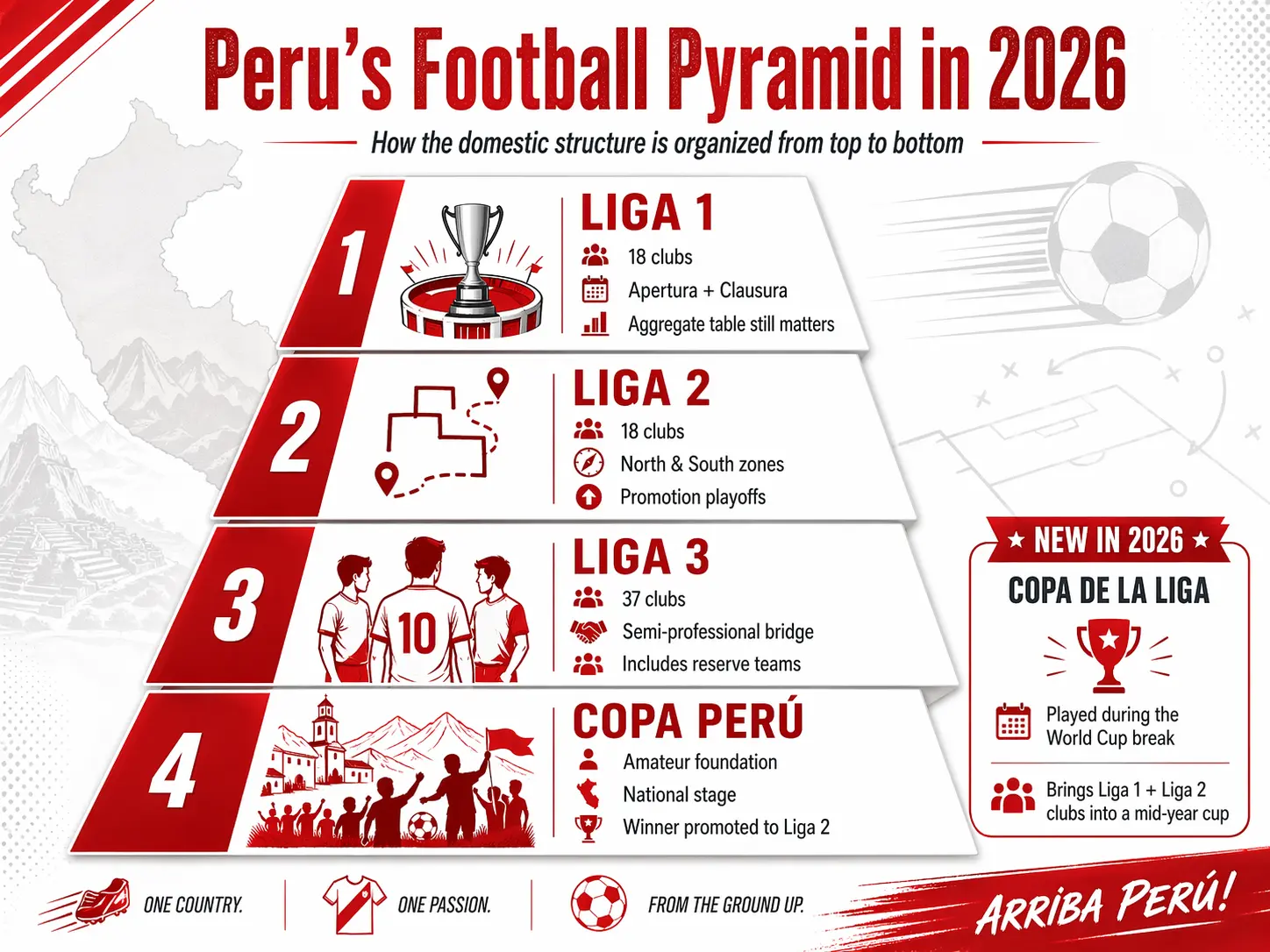
Peruvian football feels more structured in 2026 than it has in years. Instead of looking like a loose collection of disconnected competitions, the system now works much more like a defined pyramid: Liga 1 at the top, Liga 2 beneath it, Liga 3 as the new semi-professional bridge, and Copa Perú as the amateur base. On top of that, the calendar now includes a mid-year Copa de la Liga to keep clubs active during the 2026 World Cup break. For fans, that makes the domestic game easier to follow. For bettors, it makes the market more interesting, but also a lot more complex.
That complexity is exactly why understanding the structure matters. Betting on Peruvian football is not just about recognizing club names or looking at the table. It is also about reading the competition format, the playoff incentives, the pressure created by promotion and relegation, and the very real physical demands caused by geography, travel, and climate. If you treat every Peruvian football match as if it belongs to one flat ecosystem, you will miss some of the biggest edges in the country’s football calendar.
Liga 1 is the headline competition, but it is not a simple season
At the top of the pyramid sits Liga 1 Te Apuesto 2026, which is being played with 18 clubs. The season keeps the familiar Apertura and Clausura split, with each team playing 17 matchdays in each half of the campaign for a 34-match regular season. But the championship race is not determined by those short tournaments alone. The accumulated table also matters, because it is used to shape the playoff path, allocate continental places, and decide relegation. If a club wins both Apertura and Clausura, it becomes national champion automatically. If not, the title route depends on a mix of short-tournament winners and accumulated-table finishers, with a direct final place available for a short-tournament winner that also finishes in the top two overall.
That matters because Liga 1 does not reward a hot start as much as casual bettors often assume. A team can win early headlines in the Apertura and still lose strategic ground if it slips in the aggregate race. The format pushes clubs to think across the full season, not just in short bursts, and that creates a more layered betting environment. Futures, playoff qualification angles, and even match-to-match rotation decisions make more sense when you remember that the aggregate table is always in the background.
Peru creates some of the most unusual home advantages in South America
One of the biggest reasons Peru is such an interesting betting market is that the football is shaped by geography in a very literal way. This is not a league where every away day feels roughly the same. The 18 Liga 1 clubs are spread across locations that create very different playing conditions, and those conditions are not cosmetic. They affect tempo, recovery, travel, and the physical profile of the game itself. The 2026 structure still forces clubs to move between Lima, the Andes, and other demanding venues, which means altitude, climate, and logistics remain central to how matches unfold.
That is why home advantage in Peru often has more substance than in flatter betting markets. A trip to Cusco is not the same as a trip to Lima. A match in a high-altitude venue places different demands on a team than one at sea level, and over time those differences show up in pricing, squad choices, and in-play fatigue. Bettors who only look at brand value can get trapped here. The bigger club is not always the better bet when the travel profile, altitude exposure, and fixture congestion all work against it. Peru rewards context-heavy betting more than name-heavy betting.

The 2026 Copa de la Liga adds a completely different layer to the calendar
Another reason the 2026 season stands out is the introduction of the Copa de la Liga. The tournament is scheduled for June and July, during the period when Liga 1 pauses for the World Cup. At announcement, it was presented as a way to keep clubs active and visible instead of leaving a dead zone in the middle of the domestic season. Reporting around the launch said the competition would include clubs from Liga 1 and Liga 2, while the final format and exact reward structure were still being worked out.
For bettors, that is potentially one of the most interesting additions of the year. Mid-season cups create different incentive structures than league matches. Some teams may treat the tournament as a real opportunity for silverware and continental relevance. Others may see it as a squad-management tool, especially if injuries, transfer business, or league priorities dominate their thinking. When a competition sits between the first and second tiers, the motivation gap can become just as important as the talent gap. That usually means better opportunities for sharp bettors, but it also means more lineup uncertainty and more caution around early prices.
Liga 2 is more regional, more brutal, and more revealing than many bettors realize
Below Liga 1, Peru’s second tier has been reworked around geography. Liga 2 in 2026 is split into Zona Norte and Zona Sur, with nine teams in each group. The format was designed in part to reduce travel costs and cut some of the financial strain that has historically made second-division football in Peru unstable. The season is set up to reward strong regional performance first, then escalate into promotion playoffs where the best group finishers get structural advantages. The zone winners go straight to the semi-finals, and promotion is decided through a demanding sequence that includes a direct champion and a repechage path for the second promotion slot.
That gives Liga 2 a very different betting rhythm from Liga 1. Regional clustering usually means better local knowledge matters more, while promotion pressure intensifies quickly because the path upward is narrow and emotionally expensive. Clubs are not just chasing points; they are chasing survival, cash flow, relevance, and, in some cases, recovery from recent failure. The guide you provided also highlights that Deportivo Binacional remains in Liga 2 and carries a powerful altitude advantage into the second tier, while clubs such as Universidad César Vallejo and Carlos A. Mannucci entered 2026 under intense promotion pressure after recent setbacks. In a league like that, motivation is not a side note. It is part of the price.
Liga 3 finally gives Peru a proper middle layer
For years, one of the hardest things about understanding Peruvian football was the gap between the professional and amateur worlds. Liga 3 is supposed to fix that. In 2026, it functions as a semi-professional bridge between Liga 2 and Copa Perú, with a 37-club composition that mixes retained sides, promoted amateur clubs, and reserve teams from major top-flight institutions. That alone makes it important. Peru now has a more logical development ladder, which should, over time, make promotion and relegation less chaotic than before.
The presence of reserve teams is especially interesting because it changes the character of the third tier. Matches at this level are no longer only about hardened provincial sides trying to climb. They also include academy-driven teams connected to major Liga 1 clubs, which introduces a very different tactical and developmental profile. For bettors, this can create volatility. Reserve sides are often talented but inconsistent, and lower-tier information flow is usually thinner than it is in top-flight leagues. That does not make Liga 3 unbettable, but it does mean you should treat it as a specialist market rather than an extension of Liga 1.
Copa Perú is still romantic, but it is much less forgiving now
Copa Perú still carries that “anything can happen” reputation, but the 2026 version is much more streamlined than older editions. The national stage has been cut from 64 teams in 2025 to 50 teams in 2026, and the competition now uses a clearer progression: a six-match regionalized first phase, a single national general table to select the top 32, and seeded knockout rounds. From the quarter-finals onward, the tournament shifts to Lima, where the remaining rounds are played as single-elimination matches. The champion jumps straight into Liga 2 for 2027, which is a massive prize for a club coming out of the amateur game.
That makes Copa Perú both more watchable and more ruthless. Centralizing the final rounds in Lima removes some of the wild local conditions that used to define the tournament, but it also compresses the margin for error. Single-elimination football is already volatile; single-elimination football after a long, attritional amateur campaign is even more so. For bettors, Copa Perú is not usually the place for lazy accumulators or brand-based assumptions. It is a competition where format awareness matters almost as much as team quality.

So what does all of this mean if you actually want to bet on Peruvian football?
The first thing it means is that “Peru football betting” is too broad to be useful on its own. Liga 1, Liga 2, Liga 3, Copa Perú, and the new Copa de la Liga all behave differently. They have different information environments, different motivational pressures, different travel patterns, and different squad-management issues. A bettor who understands Liga 1 title incentives may still be badly misreading a Liga 2 promotion spot or a Copa Perú knockout tie. In Peru, the competition format is not background information. It is part of the market itself.
The second thing is that home context matters more than usual. In some countries, bettors can get away with treating home advantage as a small baseline adjustment. In Peru, that can be a mistake. Altitude, travel, and recovery create a more exaggerated version of the home-away split, especially when clubs move across very different environments inside short fixture windows. The more compressed the schedule becomes, the more those details matter. That is one of the reasons the Peruvian calendar rewards bettors who do homework instead of just shopping for a popular line.
The third is that promotions should come after analysis, not before it. If you are comparing sportsbook options in general, Criptonizando’s guide to the best betting sites is a useful starting point because it is built around platform type, bonuses, and betting use cases. If your actual focus is the Peruvian football calendar, it makes much more sense to compare the Stake promotion only after you already know which competitions, match types, and staking rules make sense for you.
That order matters because Peru’s regulator does not frame betting as a free-for-all. MINCETUR has explicitly said that responsible bettors should plan both time and money, avoid borrowing to gamble, and use only authorized platforms, because regulated operators are subject to technical and security rules around transparency, personal data, and prize payments. The same official guidance also reminds users that betting is limited to adults and warns that unauthorized sites can expose people to fraud and loss of funds. So if you are going to bet on Peruvian football, the smartest edge is still discipline first, promotion second.
Why the 2026 season is especially valuable for informed bettors
This season is not just another chapter in the usual Apertura-Clausura cycle. It is a year in which Peru’s football structure is visibly tightening. The top division has a more demanding incentive model. The second tier has been reorganized around sustainability and regional logic. Liga 3 is giving the pyramid a missing layer. Copa Perú is still dramatic, but more selective. And the World Cup pause is being filled by a new domestic cup that could create fresh betting angles in the middle of the year. Taken together, that makes 2026 one of the most structurally interesting Peruvian seasons in a long time.
For casual fans, that may simply make the domestic game more compelling. For bettors, it should do something else: force better habits. Peru is not a market where you want to rely only on club reputation, last-week form, or whichever operator is shouting loudest about a bonus. It is a market that rewards understanding the ladder, the calendar, and the context. The bettor who treats all Peruvian matches as interchangeable will probably find the season frustrating. The bettor who understands how the pyramid works will at least be asking the right questions.
FAQ
How does the 2026 Liga 1 title format work in Peru?
Liga 1 uses 18 clubs, split across an Apertura and Clausura with 17 matchdays each. The accumulated table still matters heavily, and the title path depends on whether the short-tournament winners also finish high enough in the overall standings. A club that wins both Apertura and Clausura becomes national champion automatically.
Why is home advantage in Peru such a big betting factor?
Because Peru’s league map creates real physical differences between venues. Clubs play across locations shaped by altitude, climate, and difficult travel, so away matches are often more demanding than they look from the table alone.
What is the Copa de la Liga in Peru?
It is a new domestic competition scheduled for June and July 2026 during the World Cup break. It was announced as a way to keep clubs active while Liga 1 pauses, and reporting at launch said it would involve clubs from Liga 1 and Liga 2, though the exact format and reward structure were still being finalized at that stage.
Is Liga 2 worth following for betting?
Yes, but it should be treated as a specialist market. In 2026 it is split into North and South zones, and its promotion route is playoff-heavy and emotionally intense. That creates opportunity, but it also means you need better local context and more caution than in a mainstream top-flight market.
What is the safest way to approach betting on Peruvian football?
Start with the competition structure, then the matchup context, then the sportsbook. MINCETUR’s guidance is clear that betting should happen only on authorized platforms, with planned limits on time and money, and without borrowing to chase results.